Key points
- N159 is a star-forming region in the Large Magellanic Cloud, about 161,000 light-years away; the image spans roughly 230 light-years.
- Webb's NIRCam image: orange glow is PAHs in dusty gas; blue pools are ionised hydrogen.
- The Papillon Nebula, a compact pocket of star birth inside N159, was first resolved by Hubble in 1999.
- The Cloud's low metallicity makes N159 a window on star formation in the early Universe.
- Image from Webb observing programme 5114; research by Habel and colleagues, arXiv 2026.
The picture
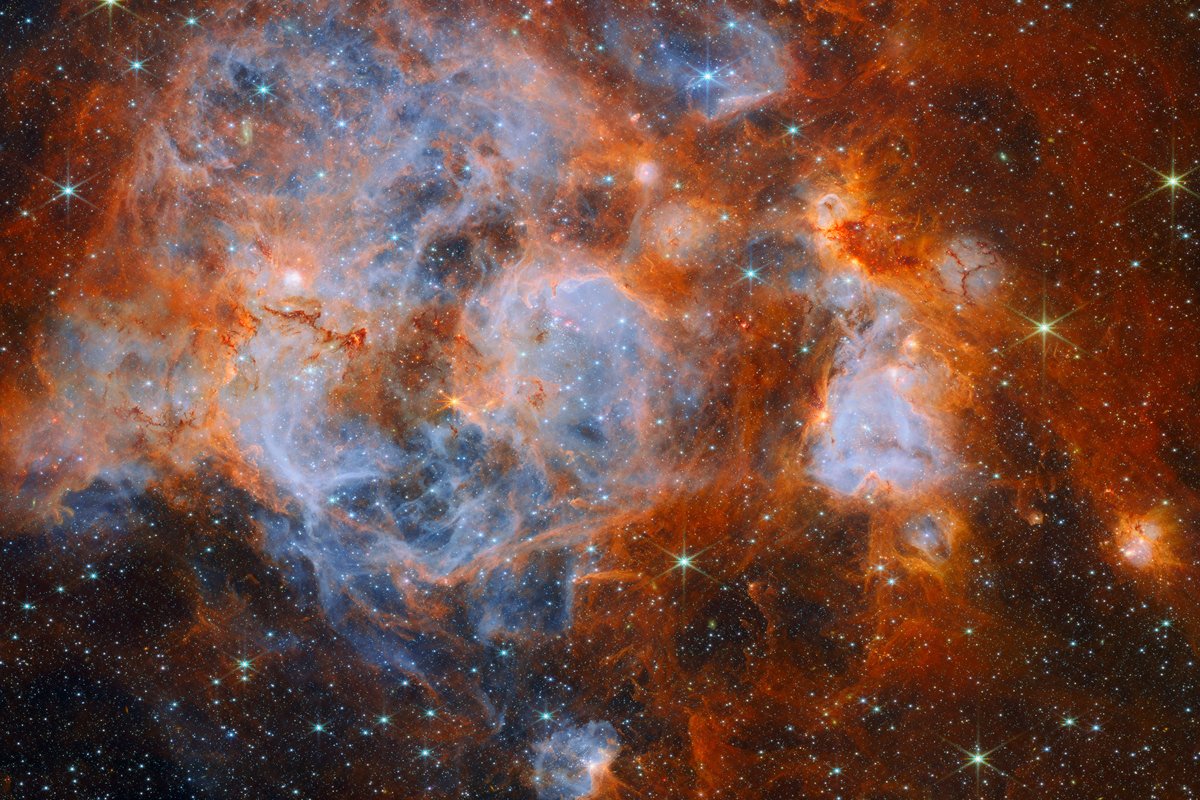
N159, also known as LHA 120-N 159, is a star-forming H II region in the Large Magellanic Cloud, a satellite galaxy of the Milky Way about 161,000 light-years away, ESA/Webb reported. The image spans roughly 230 light-years — a cauldron of gas and dust in which thousands of stars are at their earliest stages, in one of the youngest star-forming regions in the Large Magellanic Cloud, less than three million years old.
Three million years sounds like a long time, until you put it beside the Sun's age of about 4.6 billion years. These stars are, in cosmic terms, newborns. And because the region is so young, Webb is catching star formation almost at the moment of birth — the phase when gas clouds collapse, heat up and begin to shine, before the new stars blow their nurseries apart. Read more: A daily handful of peanuts changed older brains' response to insulin — but what does that really mean for your memory?
Reading the colours
| Item | Figure |
|---|---|
| Distance | About 161,000 light-years (Large Magellanic Cloud) |
| Image span | Roughly 230 light-years |
| Instrument | Webb NIRCam, observing programme 5114 |
| Papillon Nebula | First resolved by Hubble in 1999 |
| Research | Habel and colleagues, arXiv 2026 |
Webb's Near-Infrared Camera, NIRCam, took the image, and its colours are a map, not decoration. The orange glow comes from polycyclic aromatic hydrocarbons — complex carbon-based molecules, often called PAHs — in the dusty gas around the young stars. The blue pools are ionised hydrogen gas, the H II gas that gives the region its classification: hydrogen atoms stripped of their electrons by the fierce ultraviolet light of hot young stars.
The dark red filaments threading the scene are cool molecular hydrogen — the densest part of the cloud, shielding the newest stars inside. Those filaments will melt away as the young stars grow stronger and their radiation and winds clear the gas around them. In other words, the picture shows a nursery at the exact moment before the children start demolishing the nursery.
The Papillon
Look to the left of the image and you will find a bright spot: the Papillon Nebula, a compact blob of ionised hydrogen that Hubble first resolved in 1999, ESA/Webb reported. It is a small, intense pocket of star birth inside the larger region — a reminder that star formation does not happen evenly. It happens in knots and bursts, wherever the gas is densest and the collapse begins first.
That unevenness is the heart of the science. The western region of N159 contains more concentrated young stellar objects, indicating an earlier collapse stage, while the southern region is even less evolved, according to the research behind the image. Star formation here is sequential: one generation's collapse triggers the next, in a chain reaction across the cloud.
Why it matters: a window on the early Universe
The Large Magellanic Cloud has a significantly lower metallicity than the Milky Way — that is, its gas contains far fewer elements heavier than hydrogen and helium. That matters because the early Universe was also metal-poor: the first generations of stars formed from almost pure hydrogen and helium, and only later generations enriched the cosmos with heavier elements through supernovae.
Studying star formation in a low-metallicity environment like N159 therefore tells astronomers how stars formed when the Universe was young. The Webb observations detected stars with less than a tenth of the Sun's mass, pushing the census of this region down to objects far fainter than previous telescopes could see. The more complete the census, the better astronomers can test whether star formation works the same way in metal-poor gas as it does in our own galaxy — or whether the rules change.
Hubble featured the east and west sides of N159 in 2025, ESA/Webb noted. Webb's new wide view puts those pieces together, in infrared light that pierces the dust Hubble could not see through, and reveals the full cauldron at once.
The science behind the image
The image comes from Webb observing programme 5114, ESA/Webb reported. The underlying research is by Nolan Habel and colleagues, "Sequential Star-Formation and the Near-Infrared Stellar Populations within N159", published on arXiv in 2026 (DOI: 10.48550/arxiv.2609.27126).
That paper is the reason this picture is more than a pretty image. It is a measurement: a census of young stellar objects, mapped by age and location, showing that star formation in N159 proceeds in sequence, from region to region, rather than all at once. The cauldron is not just brewing stars. It is brewing them in order — and Webb has caught the order as it unfolds.
Updates & corrections
Published 27 October 2026.
No updates or corrections have been made to this article since publication.
Sources and notes
- ESA/Webb (Picture of the Month, 22 October 2026), on N159: distance, age, size, colours, the Papillon Nebula, observing programme 5114 and the underlying paper: esawebb.org
- Phys.org (22 October 2026), reporting on the Webb N159 image: the star-forming region, the young stellar populations and the low-metallicity context: phys.org