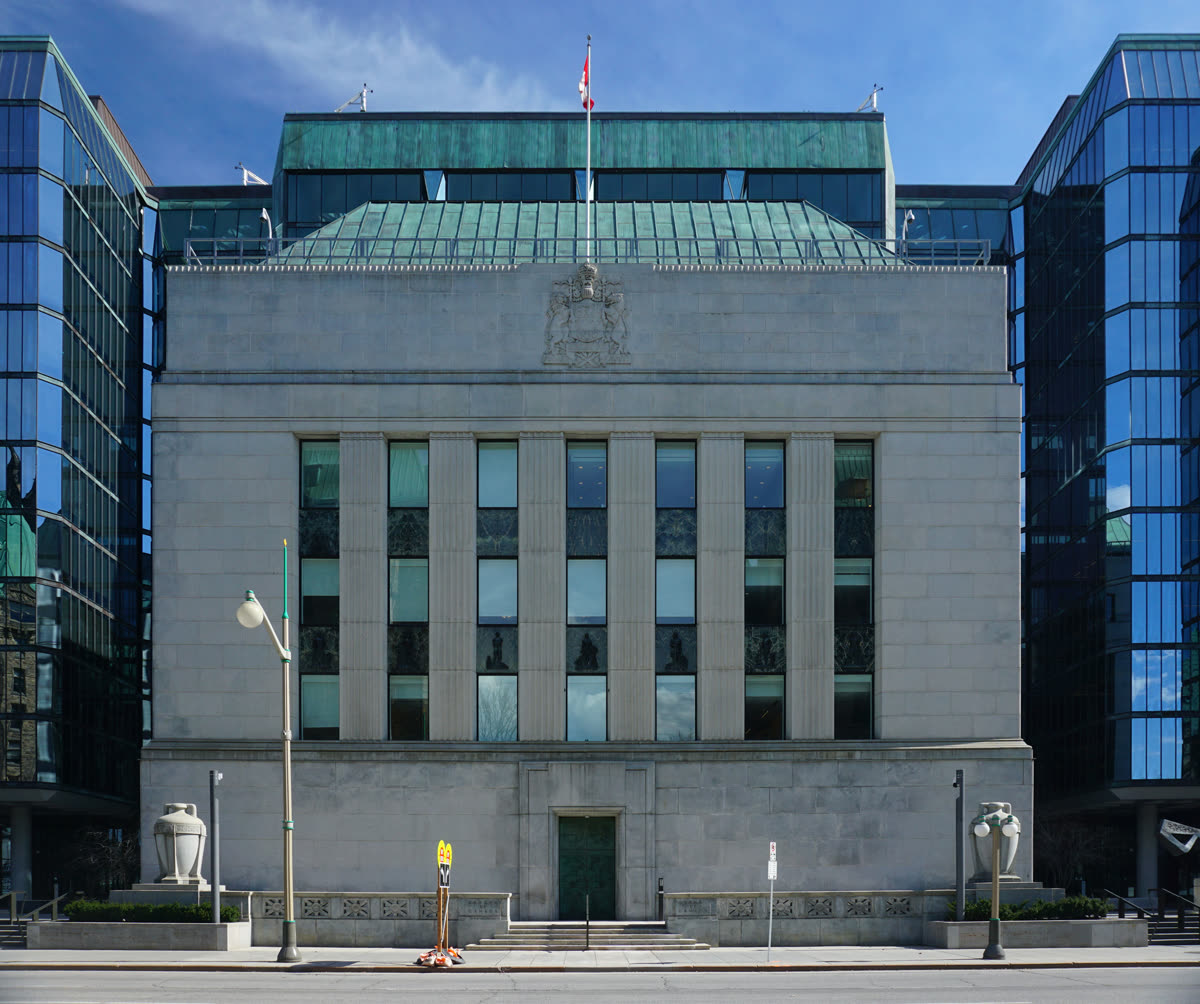
Key points
- The Bank of Canada raised its target for the overnight rate by 25 basis points to 2.5% on Wednesday 28 October 2026, the bank announced — its first increase since July 2023.
- The Bank Rate now stands at 2.75% and the deposit rate at 2.45%, the bank said, after the policy rate had been held at 2.25%.
- Consumer price inflation has been around 3% since April and is expected to rise to about 3.5% by the end of the year, the bank said, averaging 3% through much of 2027 before returning close to the 2% target by the middle of 2028.
- Governor Tiff Macklem said there could be a need to raise the rate further, but that the bank will proceed carefully — its next scheduled rate decision is on 9 December 2026.
The Bank of Canada has raised interest rates for the first time in more than three years, acting against an inflation outlook it says has deteriorated since its July report. The quarter-point move, announced in Ottawa on Wednesday, was widely expected by economists polled by Reuters, 19 of 34 of whom had forecast a rise to 2.5%. It is the bank's first policy change in a year. Read more: New Zealand's central bank shocks markets by holding rates at 2.75% in a 4–3 vote
The key figures
| Measure | Figure | Source |
|---|---|---|
| Policy rate after the decision | 2.5%, up 25 basis points from 2.25% | Bank of Canada |
| Bank Rate / deposit rate | 2.75% / 2.45% | Bank of Canada |
| Previous rate increase | July 2023 | Bank of Canada / Reuters |
| Consumer price inflation | Around 3% since April; about 3.5% expected by year-end | Bank of Canada |
| Inflation excluding petrol, September | 2.2%; core measures close to 2% | Bank of Canada |
| Inflation expected to average, 2027 | 3%, a percentage point above the July projection | Bank of Canada |
| Growth forecast | 1% in 2026; 2% in 2027 and 2028 | Bank of Canada |
| Unemployment rate | Around 6.5% for several months | Bank of Canada |
| Next scheduled rate decision | 9 December 2026 | Bank of Canada |
Why the Bank moved now
Governor Tiff Macklem pointed to two developments since July, in remarks published by Reuters. First, the inflation outlook has worsened: with the war in the Middle East now in its eighth month, the bank said, global oil prices have increased and are expected to remain higher for longer, hitting Canadians at the petrol pump and raising costs for many businesses. Second, the growth outlook has improved modestly, despite continued trade action by the United States — growth picked up through the middle of the year, and exports and business and government investment are expected to support a further recovery.
The danger, as the bank frames it, is not the petrol price alone but what follows it. Fuel prices raise the costs of production and transport, imported industrial and electronics input prices have also increased, and while businesses have mostly absorbed higher costs so far, the bank's surveys suggest that pass-through to consumer prices will increase over the next year. With the economy expected to recover, the bank said, there is less downward pressure on prices to offset those cost pressures — which is why, in Macklem's words, an increase was needed to reduce the risk that elevated energy prices spill over and become generalised inflation.

The case for holding — and why it lost
The decision was not one-sided. Macklem set out the argument for holding rates steady: the rise in inflation has so far been concentrated in energy prices and in services that rely heavily on energy, such as airfares; inflation excluding petrol was 2.2% in September and core measures remain close to 2%; economic slack remains; and new US tariffs will weigh on growth in the fourth quarter. The economy, the bank noted, grew 3.3% in the second quarter and recent indicators point to about 2% in the third, but growth is expected to slow in the fourth quarter as new tariffs bite, before picking up again in 2027.
Against that, the governing council judged that the balance of risks had shifted. Energy prices are higher, they are expected to stay higher, and cost pressures are building — the longer they last, the more likely they spread. Some economists disagreed with the move: Reuters reported one senior economist at CIBC Capital Markets arguing that core inflation would not accelerate as much as the bank fears, particularly if global energy prices ease, and that the policy rate would not need to move above 2.75% — the midpoint of the bank's neutral range, below which the new 2.5% rate still sits. That disagreement is now the live question for the December meeting.


What happens next
For households, the immediate effect runs through borrowing costs: Reuters reported that the increase would likely push up bank lending rates and mortgage costs, though fixed mortgage rates move with bond yields as well as with the policy rate, so not every rate moves by the same amount or at once. The Canadian dollar, the bank said, had recovered to around 71 US cents, the same as assumed in its July report. The bank's next Monetary Policy Report is due on 27 January 2027, and its next rate decision comes sooner, on 9 December — the meeting at which markets and economists will test whether Macklem's warning about further rises was a signal or simply caution. Europe Unfolded will report that decision when it is announced.
Updates & corrections
Published 28 October 2026.
No updates or corrections have been made to this article since publication.
Sources
- Bank of Canada, press release, 28 October 2026, on the 25-basis-point rise to 2.5%, the Bank Rate of 2.75% and deposit rate of 2.45%, growth of 1% in 2026 and 2% in 2027 and 2028, inflation around 3% since April rising to about 3.5% by year-end and averaging 3% in 2027, inflation excluding petrol at 2.2% in September, the Canadian dollar at around 71 US cents, the next rate decision on 9 December 2026 and the next Monetary Policy Report on 27 January 2027: bankofcanada.ca
- Reuters, full text of Governor Tiff Macklem's statement, 28 October 2026, on the first increase since July 2023, the two developments since the July report, GDP growth of 3.3% in the second quarter and about 2% in the third, unemployment around 6.5%, the case for holding and the case for hiking, and that there could be a need to raise the rate further but the bank will proceed carefully: reuters.com
- Reuters news report, 28 October 2026, on the hike as widely expected, the upgraded growth outlook, the neutral-rate midpoint of 2.75%, the likely pressure on bank lending and mortgage costs, and the CIBC view that the policy rate need not move above 2.75%: wdsm710.com